
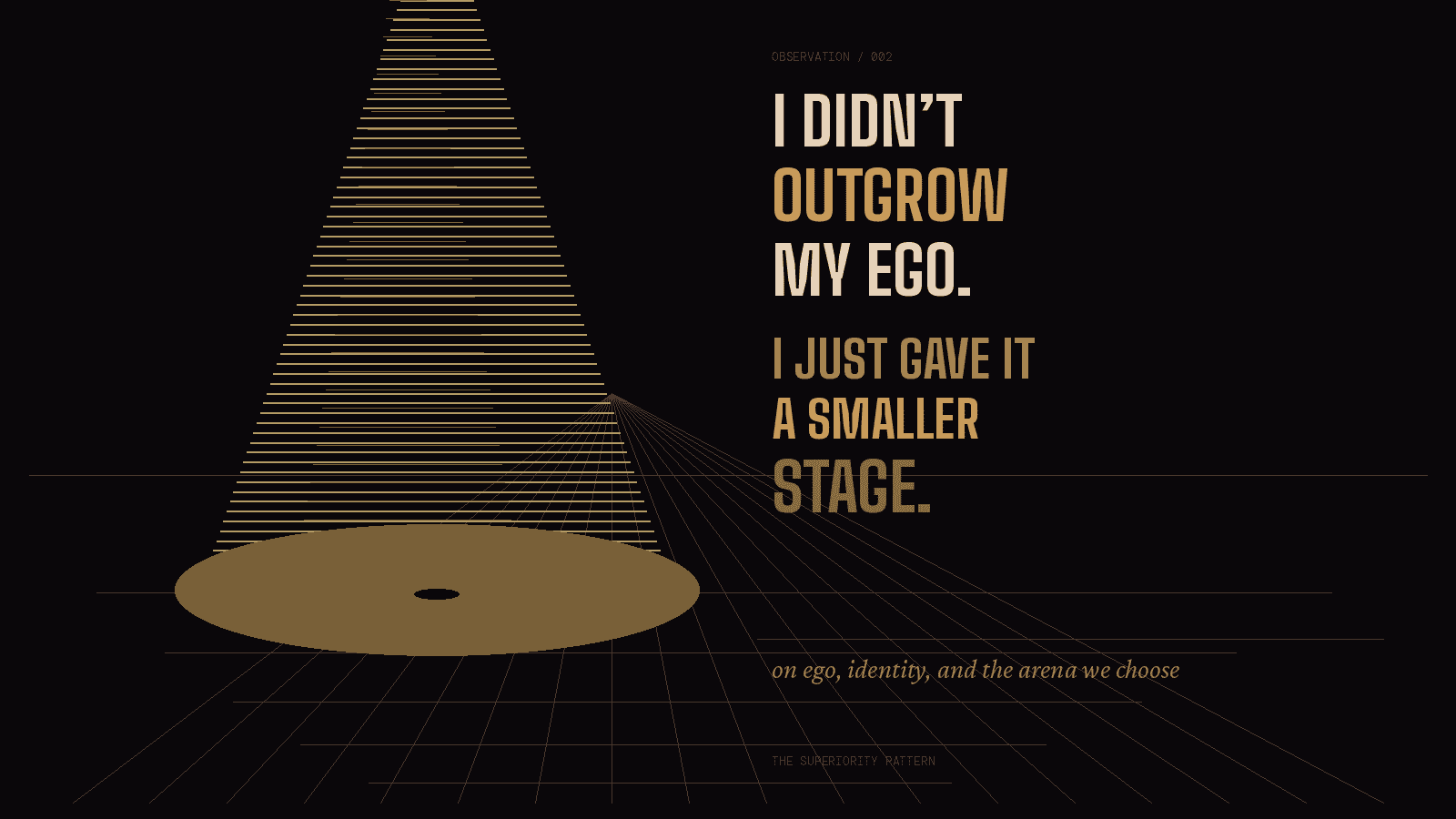
I Didn’t Outgrow My Ego. I Just Gave It a Smaller Stage.
A few weeks ago, I was in a conversation with a close family member who just up and told me I used to have narcissistic tendencies. They quickly added that they thought I had changed, and were really proud of me.
WTF!
Me? No way.
Yeah, I pushed back. I asked what they meant. They explained — not a full-blown narcissist. “Tendencies.”
What does that mean, I asked, desperately looking for a way out, anyway out, this could not be true.
“Ok, you had to feel superior. Always needing to be right. You always needed to be the best in the room. But you are different now.”
I sat with that for a few days.
Then I asked a second person I trust — someone who’s known me a long time. Same answer. Yes, that used to be you. And yes, you have changed, for the better.
Well, at least I changed. So that’s good.
Later, still relieved that I had changed, I began to wonder.
Did I actually change? And what did I do to change? What made that happen?
What does change even mean? Did I just stop acting superior — because I feel like I still feel the need to be good at things, better than others at things?
I decided to backtrack to my earlier self and see if I could parse this out.
The Environment That Built It
The pattern made sense in context. I spent decades in executive roles — building companies, running teams, fixing problems, always needing to be right for the betterment of the business. Those environments didn’t just reward that.
They required it. It was a job description. I was really good at it.
And then it happened — within one year at one point in my career, I lost my dad, got divorced (which disengaged me from my children), and then lost my job when the technology underpinning the startup I’d been CEO of failed to meet its clinical endpoints.
The global recession made it hard to find meaningful work. Eventually, the roles I stepped back into had huge hills to climb — technically brutal, emotionally demanding. Those environments rewarded the armor. They needed me to be the guy who was always right, always in front, always the best in the room.
My dad used to say: set your nose in the wind and don’t look back. That attitude got me through a lot of tough times.
I began to ask — why does it have to be this hard? And, aside from the environments I was choosing to work in, what role did needing to be the best in every room play in why it always was?
Eventually I stepped away from the corporate world to feed my lifelong dream of owning my own business. The stress of true entrepreneurship was very real — but I felt I was truly (literally!) investing in myself and that was so much more palatable.
But the need to be right was still there, just turned inward now. Just me.
If the magic formula was threefold — being good at something, making a good living at it, and loving it — I’d achieved two of them in the corporate world. I found the same pattern with my own business: still the first two out of three.
Fortunately, I’d replaced one kind of stress with another, more palatable one.
But I was still missing the third leg.
And then I rediscovered martial arts. And everything changed.
The New Arena
But I’m not in those rooms anymore. I’m on the mat. I’m 70 years old learning martial arts. And two people I trust just told me the pattern is gone.
So why do I still feel it?
I’m pretty athletic for 70. That part is real. But I notice how invested I’ve gotten in that. Being the best 70-year-old. Being the one people look at and say wow, you’re incredible for your age.
And here’s the mind candy — the part I’m almost embarrassed to admit. When someone says that, part of me redraws the target to a size I can still dominate. A smaller arena where I can still be superior.
Same pattern. Different costume.
Drive Is Not The Enemy
There’s something important I want to make clear here.
Wanting to win is not the problem. Competitiveness is not the problem. Drive is not the problem.
Drive is how I built companies. Competitiveness is how I got back up after the worst year of my life. Wanting to be the best pushed me to get better at things that mattered.
There’s nothing wrong with any of that.
The problem is when winning becomes the proof of your worth. When being the best stops being a goal and starts being a requirement. When your nervous system can’t tolerate not being the best in the room — not because it drives you to improve, but because it needs the superiority to feel safe.
That’s drive gone rogue. That’s ego using competitiveness as armor.
The question isn’t — do I want to win?
The question is — can I be okay if I don’t?
Did I Change Or Did I Just Hide It Better?
This is the question I keep sitting with.
Because there’s a difference between changing a pattern and getting smarter about concealing it. There’s a difference between releasing a need and relocating it somewhere more socially acceptable.
The trap is that the new arena is legitimate. I am athletically good for 70. The pursuit of mastery in martial arts is real. Both things are true.
But I can be genuinely pursuing mastery and simultaneously hiding a need for superiority inside that pursuit. The ego is clever that way. It finds new costumes.
Corporate Ray needed to be the best executive. Athletic Ray needs to be the best 70-year-old on the mat. Different costume. Same mentality.
What Change Actually Means
Here’s where I am right now.
Change isn’t suppressing the pattern. It isn’t relocating it. It isn’t even managing it better.
True change is releasing the identity attachment underneath it.
Superiority isn’t just a behavior. It’s a need that manifests when we identify with a role so completely that we need to be the best at it to feel okay. Executive, athlete, martial artist — the role doesn’t matter. The attachment does.
Real change means you can play a role fully — give everything to it — without being “it.” Without needing it to say something about your worth.
Mastery points us in exactly that direction. To truly master something is to be fully present in it — improving always, releasing always, not because it proves who you are but because the work itself is worth doing.
The journey toward mastery is the journey toward releasing identity.
The Remedy Is Simpler Than You Think
When I catch the pattern now — the mind candy, the redrawing of the target, the quiet internal ranking — I don’t fight it.
I just name it.
That’s my ego. Wanting to feel superior. Hanging onto something.
And then I ask: how do I want to react to this?
Someone tells me I’m incredible for 70. I can receive that with genuine gratitude. A person said something kind. That’s it. I don’t need to inflate it into proof of something.
I definitely don’t need to deflect it with false modesty.
I can just say thank you. And mean it.
Sadhguru talks about this. So does Viktor Frankl. But I didn’t find it in a book. I found it in a martial arts class when someone told me I was incredible for my age and I felt the ego light up.
Response-ability. The ability to choose how I respond.
The compliment lands. The ego perks up.
And then I am responsible for what happens next. No one else. Just me.
That’s not a small thing. That’s everything.
Suffering comes from attachment. In this case, attachment to needing. When a compliment becomes something you need to feel okay, you’ve handed your worth to other people. That’s fragile. That’s exhausting. That’s the trap aging will eventually spring on you whether you like it or not.
Train hard. Compete fiercely. Pursue mastery. And let the compliment just be a compliment.
That’s the practice. That’s the whole thing.
———
If this resonated with you, you might also enjoy:
What Learning Martial Arts Finally Taught Me About How I React — push, collapse, presence — the three ways I respond when I’m learning something hard
The Observer Advantage: Martial Arts Psychology for Strategic Thinking — how watching your own patterns changes everything
Learning to Surrender in BJJ — why letting go is one of the hardest things you’ll do on the mat
BJJ Over 40: Complete Guide for Beginners — if the aging piece hit home, this one’s for you


